Individuals


 Allied Health

 Medical Practitioners


Nearly a decade after the publication of the 2017 International Classification of the Ehlers-Danlos Syndromes, significant change is approaching [1, 2]. The Road to 2026 is an international scientific program reviewing how Ehlers-Danlos syndromes (EDS), hypermobile Ehlers-Danlos syndrome (hEDS) and hypermobility spectrum disorders (HSD) are classified, recognised, diagnosed and ultimately managed [3]. Importantly, the Road to 2026 work is happening at a time when research is also challenging some long-held assumptions about hEDS and HSD, particularly how distinct these two diagnoses really are [4].
This article looks into what’s shaping the new diagnostic criteria and classification frameworks.
❓ THE BIG QUESTION
Are hEDS and HSD truly separate conditions, or are they overlapping presentations within a broader biological and clinical spectrum?
WHAT is the Road to 2026?
The Road to 2026 is the pathway towards updating the 2017 International Classification of EDS and HSD. It includes a comprehensive review of the classification framework for all EDS types and HSD, together with research examining how hEDS and HSD relate to each other and whether the current diagnostic criteria accurately represent the people living with these conditions [3].
One of the major studies informing this work is the international hEDS/HSD Criteria Review Study. It has examined hundreds of people with hEDS, HSD and other chronic pain conditions across several countries. Researchers have found that no single clinical feature or measurement clearly separates hEDS from HSD [4]. Certain combinations of findings may help identify people within the broader hEDS/HSD group, but the distinction between hEDS and HSD is much less clear. These findings support growing evidence that hEDS and HSD may exist on a shared spectrum with considerable overlap in clinical presentations, extracellular matrix (ECM) processes and features, and associated conditions [5, 6].
WHY does the classification need to change?
As of today, hEDS and HSD remain separate diagnoses.
However, scientific understanding, interconnected body systems knowledge and genetics research have moved considerably since the original criteria. The 2017 classification was an important step forward. It established clearer diagnostic criteria for hEDS and introduced the HSD framework for people with symptomatic joint hypermobility who did not meet criteria for another defined connective tissue disorder [1].
Our understanding of connective tissue has changed. EDS and hEDS were once explained mainly as a problem with collagen and joint looseness, but research now shows a much more active system involving the extracellular matrix, fibroblasts, fascia, cell signalling, inflammation and the way cells respond to movement and load [5, 7, 8].
Clinically, the two groups can also look remarkably similar, with overlapping pain, fatigue, dizziness, gastrointestinal symptoms, dysautonomia and other health concerns. In the large 2025 international study by Daylor and colleagues, people with hEDS reported an average of 24 co-occurring conditions compared with 17 in HSD, with substantial health impacts and long diagnostic delays in both groups [9].

This strengthens the current question: Where should the boundary between HSD and hEDS actually sit?
A critical shift in our thinking is that hEDS and HSD likely involve much more than flexible joints or “faulty collagen”.
Importantly, diagnosis currently remains clinical while this research continues.
This science is still developing and does not yet give us a diagnostic blood test or biomarker. However, it shows why the classification needs to keep pace with a much broader understanding of connective tissue, biology and whole-body symptoms. There is still no validated blood test, genetic test or biomarker that can confirm or exclude hEDS or HSD.
WHO & HOW is the new framework being developed?
The Road to 2026 is led by experts from the International Consortium on Ehlers-Danlos Syndromes and Hypermobility Spectrum Disorders. The committee includes independent clinical and academic experts across different EDS types and HSD, together with paediatric expertise and community representation [3].
The Ehlers-Danlos Society provides funding, administration and support for international collaboration and helps bring lived-experience perspectives into the process. Importantly, representatives of The Ehlers-Danlos Society who sit on the Road to 2026 Committee are non-voting members. The Society states that study design, analysis, interpretation and scientific decisions are led by the clinical and academic experts involved in the work [3].
This is a global scientific initiative, not simply a rewriting of the 2017 criteria.
The process brings together:
- international scientific research
- review of published EDS and HSD literature
- global clinical expertise
- structured expert input and consensus
- clinical testing of proposed diagnostic models
- research into joint hypermobility assessment beyond the Beighton score
- investigation of symptoms and associated conditions
- genetic and biomarker research
- lived-experience surveys
- independent scientific peer review [3]

The hEDS/HSD Criteria Review Study is particularly important because researchers have examined combinations of features instead of assuming there will be one sign, symptom or measurement that separates hEDS from HSD [4]. Researchers have also evaluated additional joint assessments alongside the Beighton score and are testing proposed revised diagnostic models in real-world clinical practice [4].
So, the overarching question is: What is the most scientifically accurate and clinically useful way to understand, classify and diagnose these conditions?
WHEN will the changes happen?
The new classification and supporting research are planned for publication in two special-edition volumes of the American Journal of Medical Genetics Part C [3]. Open-access publication is being funded by The Ehlers-Danlos Society so clinicians, researchers and community members will be able to access the papers without charge [3].
The timeline looks like this…
1-2 December 2026
The first group of publications is planned to include:
- the updated International Classification
- revised classification criteria covering EDS and HSD
- assessment and treatment best-practice information for the monogenic EDS types [3]
March 2027
The second stage is planned to include:
- a clinical diagnostic pathway for EDS and HSD
- assessment and treatment best-practice guidance for hEDS and HSD
- guidance addressing symptoms, associated conditions, health, function and quality of life.
These dates are the currently published timetable and may still change as the scientific and peer-review process progresses [3].
WILL children’s and adolescents’ diagnostic criteria be impacted?
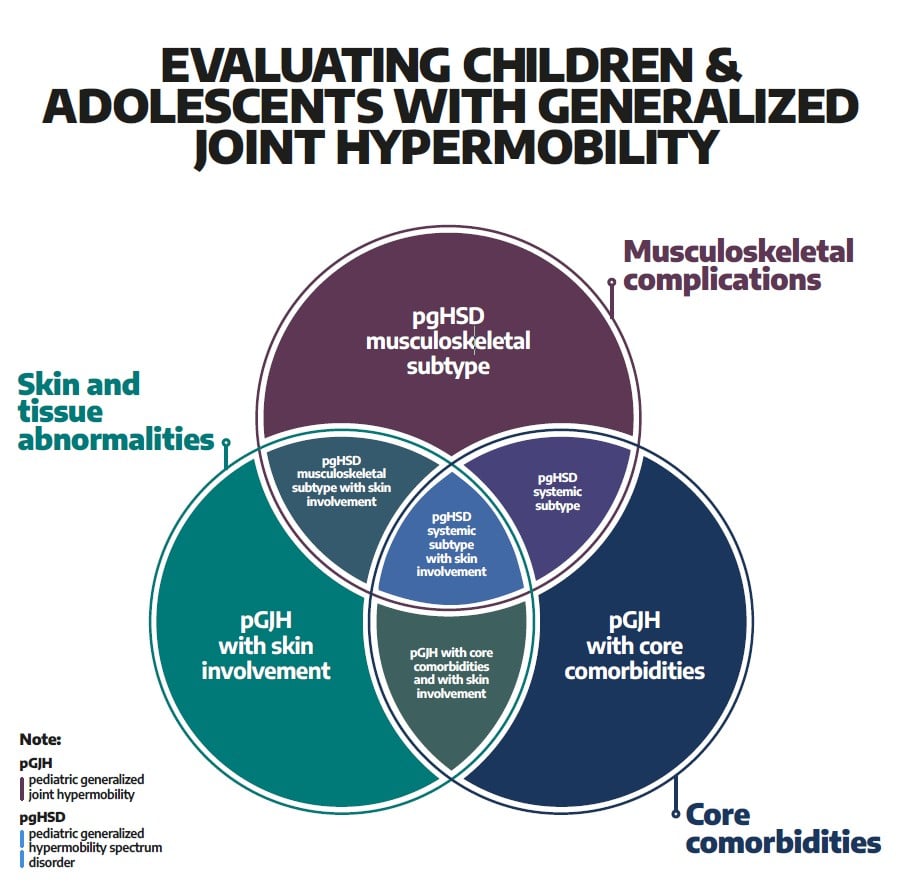
Another major shift has already begun in paediatric hypermobility. In 2023, an international group published a paediatric diagnostic framework for joint hypermobility because adult hEDS criteria can be difficult to apply to children whose bodies and symptoms are still developing [10].
The framework considers four main areas:
- generalised joint hypermobility
- skin and tissue findings
- musculoskeletal complications
- core associated conditions [10]
Rather than diagnosing hEDS in young children, the framework allows a child’s presentation to be described and reviewed over time as their body matures. This is important because some features used in adult diagnostic criteria may not become obvious until later adolescence or adulthood.
For the patients and families I work with, this is an important change in thinking. A child’s diagnosis does not need to be treated as a fixed label at one point in development. Their presentation can be monitored and reconsidered as they mature. The Road to 2026 has the opportunity to further improve the transition from paediatric assessment into adult diagnostic pathways.
What does this mean right now?
For now, hEDS and HSD remain distinct clinical diagnoses under the current diagnostic framework [1, 2]. That has not yet changed.
Current research is increasingly showing considerable clinical and biological overlap, and the Road to 2026 is directly examining:
- how hEDS and HSD relate to one another
- whether the existing names and categories should change
- which clinical features are most useful
- whether assessment of hypermobility should extend beyond the Beighton score
- how emerging genetic and biomarker research may eventually contribute
- what future diagnostic pathways should look like [3, 4]
For people who have spent years trying to understand why they received an HSD diagnosis rather than hEDS, or why two clinicians reached different conclusions, this work is particularly relevant. It does not mean that everyone currently diagnosed with HSD will automatically be diagnosed with hEDS, or that the final classification has already been decided.
Those decisions await completion of the research, scientific consensus and peer-reviewed publication.
1 December 2026 is a milestone, not the end…
The publication of the new classification on 1 December 2026 will be a major milestone. But it will not be the end of the Road to 2026. The next stage is planned for March 2027, when the clinical diagnostic pathway and hEDS/HSD assessment and management recommendations are expected to be published [3]. That is when we should begin to see more clearly how the new science translates into everyday diagnosis and healthcare.
What should you do next?
You do not need to wait until December 2026 to have your current symptoms taken seriously. HSD and hEDS can both have significant effects on pain, fatigue, joint stability, autonomic symptoms, gastrointestinal function, sleep, social participation and quality of life. Your healthcare should be based on your symptoms, function and individual needs, not simply the diagnostic label attached to them.
At Hypermobility Health Connect, we will continue to follow the research closely and provide updates as the new international classification, diagnostic pathways and clinical recommendations are published.
Are you Hypermobile, or think you may have HSD or hEDS?
Take our 15-min evidence-based online test to find out if you might benefit from professional support.
References
- Malfait, F., et al., The 2017 international classification of the Ehlers–Danlos syndromes. American journal of medical genetics. Part C, Seminars in medical genetics, 2017. 175(1): p. 8-26.
- Castori, M., et al., A framework for the classification of joint hypermobility and related conditions. American journal of medical genetics. Part C, Seminars in medical genetics, 2017.
- Society, T.E.-D. The Road to 2026: a path toward progress. [Internet] 2026 [cited 2026 08/09/2026]; Available from: https://www.ehlers-danlos.com/road-to-2026/.
- Society, T.E.-D. hEDS and HSD Criteria Review Study. [cited 2026 08/09/2026]; Available from: The Ehlers-Danlos Society.
- Ritelli, M., et al., RNA-Seq of Dermal Fibroblasts from Patients with Hypermobile Ehlers–Danlos Syndrome and Hypermobility Spectrum Disorders Supports Their Categorization as a Single Entity with Involvement of Extracellular Matrix Degrading and Proinflammatory Pathomechanisms. Cells (Basel, Switzerland), 2022. 11(24): p. 4040.
- Malek, S. and D.V. Köster, The Role of Cell Adhesion and Cytoskeleton Dynamics in the Pathogenesis of the Ehlers-Danlos Syndromes and Hypermobility Spectrum Disorders. Frontiers in cell and developmental biology, 2021. 9: p. 649082.
- White, L. and S.S. Procknow, Hypermobile Ehlers Danlos for the Primary Care Provider. Missouri medicine, 2024. 121(4): p. 289-296.
- Wang, T.J., et al., Fascial Pathophysiology in Hypermobility Spectrum Disorders and Hypermobile Ehlers–Danlos Syndrome: A Review of Emerging Evidence, in Int J Mol Sci. 2025, MDPI AG: Switzerland. p. 5587.
- Daylor, V. M.G., Amy Weintraub, Rebecca Byrd, Taylor Petrucci, Matthew Huff, Kathryn Byerly, Roman Fenner, Sydney Severance, Charlotte Griggs, Amol Sharma, Paldeep Atwal, Steven A. Kautz, Steven Shapiro, Kimberly Youkhana, Mark Lavallee, Allison Wilkerson, Michelle Nichols, Alan Snyder, Josef Eichinger, Sunil Patel, Anne Maitland, Cortney Gensemer, View ORCID ProfileRussell A. Norris, Defining the Clinical Complexity of hEDS and HSD: A Global Survey of Diagnostic Challenge, Comorbidities, and Unmet Needs. 2024.
- Tofts, J.L., et al., Pediatric joint hypermobility: a diagnostic framework and narrative review. Orphanet Journal of Rare Diseases, 2023. 18(1).
Further reading
The Ehlers-Danlos Society: The Road to 2026 – https://www.ehlers-danlos.com/road-to-2026/