Individuals


 Allied Health

 Medical Practitioners


Being flexible is not a problem in itself. Many people can bend a thumb back or drop into the splits and go through life with no pain, no injuries and nothing to manage. For others, that same flexibility comes with pain, recurring injuries, fatigue and other symptoms (and is linked with conditions such as anxiety) that may have been around for years, never quite seeming connected [1, 2, 3, 6].
The difference between those two situations has a name, and understanding it is one of the most useful things you can do for your own body, or your child’s.
Not all hypermobility is the same
Hypermobility simply means your joints move beyond the normal range of motion. Some people are naturally more flexible than others. Hypermobility is particularly common in children, is more common in females, and can also vary between ethnic groups [4, 5, 6, 7, 8]. Up to 20% of adults have some degree of joint hypermobility, and about 1 in 500 people meet the criteria for hypermobile Ehlers-Danlos syndrome (hEDS) or hypermobility spectrum disorder (HSD), conditions in which hypermobility causes symptoms and affects daily life [8, 9, 10, 11].
What matters is not whether you are bendy, but whether that bendiness causes other health problems.
- Asymptomatic hypermobility means you have increased joint flexibility without it causing significant pain, instability, injury or other health problems. You may simply be naturally flexible, and if your hypermobility is not causing problems, it generally does not require treatment (it is simply how your body is built) [11, 12].
- Symptomatic hypermobility means your joint hypermobility occurs alongside symptoms that affect your health or day-to-day life. These may include recurring joint or soft-tissue injuries, joint instability, persistent pain, fatigue, dizziness or other autonomic symptoms, gastrointestinal problems and easy bruising [11, 12, 13, 14]. Anxiety, attention deficit hyperactivity disorder (ADHD), autism and mast cell-related symptoms (such as allergy-like reactions) are also reported more often in some people with HSD/hEDS, although these are considered associated or co-occurring conditions rather than symptoms caused directly by hypermobility itself [12, 13, 14, 15].
Flexibility on its own is not a reason to worry. But recurring or unexplained symptoms alongside that flexibility deserve proper assessment.
Why the difference between asymptomatic and symptomatic hypermobility matters
It is also worth knowing that asymptomatic hypermobility can become symptomatic later, particularly after injury, repeated strain, viral illness, growth spurts, hormonal changes or other life changes. So even if your hypermobility causes no problems now, it may in future.
When hypermobility becomes symptomatic, it can reflect something broader than loose joints. Connective tissue is found throughout the body, which may help explain why symptoms can involve the muscles, nervous system (including the autonomic nervous system, which controls automatic functions such as heart rate and digestion), gut and pain-processing pathways [1, 2, 3, 13, 14, 15].
Because those symptoms can appear across different body systems, fluctuate over time and are often treated separately, the connecting thread is often missed [2]. Someone might see a physiotherapist for recurring injuries, a gastroenterologist for gut symptoms and a psychologist for anxiety, without anyone stepping back to ask whether the picture fits together [16].
Recognising symptomatic hypermobility can change that. It may help connect years of unexplained symptoms, reduce self-blame, guide safer care and support more appropriate referrals.
Hypermobility in childhood: the invisible condition we often miss
Early recognition is especially important in children. It means support can begin sooner, rather than a child experiencing invalidation.
In children, symptomatic hypermobility is often invisible. The signs, such as pain, fatigue, poor handwriting, clumsiness and coordination difficulties, are easily overlooked or put down to growing pains, anxiety or a child simply being awkward or accident-prone [4, 5, 6, 7, 8]. Because none of these looks obviously like a connective tissue issue, they are frequently dismissed, contributing to long delays before anyone connects the dots.
This is starting to change. A newer paediatric diagnostic framework helps identify children with symptomatic hypermobility earlier, before the adult hEDS criteria are appropriate to apply [8]. Earlier recognition supports earlier management and can reduce the impact on school, physical activity and family life.
For a hypermobile child, that can be the difference between learning to work with and understand their body or spending years being told there is nothing wrong and pushing through, while symptoms quietly accumulate [1].
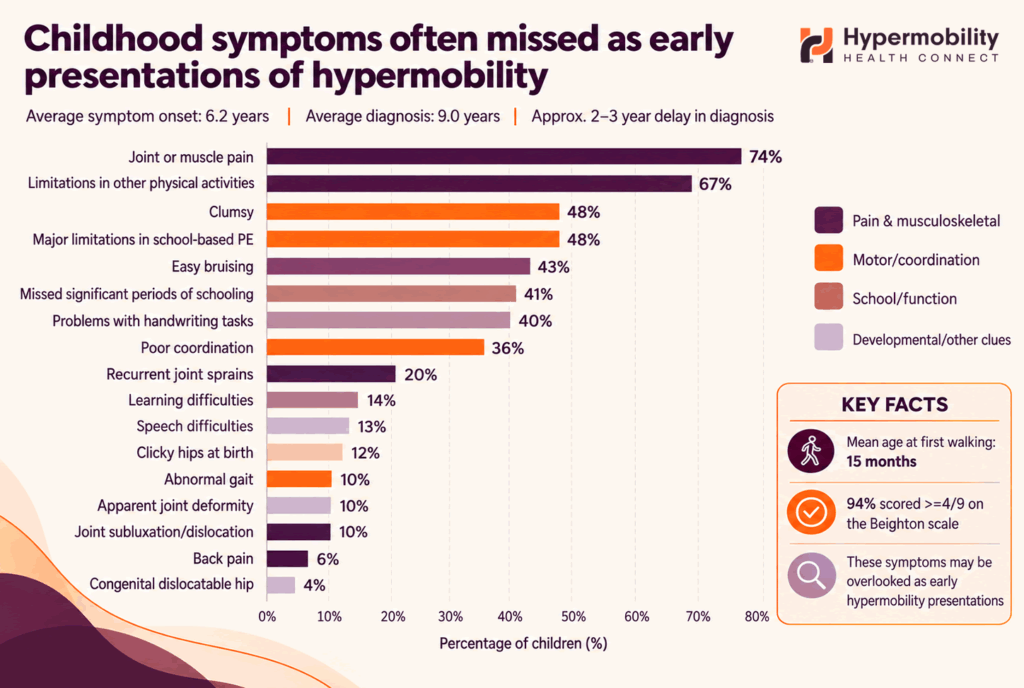
[17]
What this means for you
If you are flexible and feel well, this may simply be a reassuring read. Asymptomatic hypermobility is not something you need to fix.
But if you recognise other symptoms in yourself (or your child), such as recurring injuries, unexplained pain, fatigue or a cluster of symptoms that have never been joined up, it is worth taking seriously. Symptomatic hypermobility is generally easier to manage when it is recognised early, rather than pushed through for years.
Recognising which kind of hypermobility you are dealing with is the first step. From there, the right information, assessment and support can help you, or your child, work with your body rather than against it.
Are you Hypermobile, or think you may have HSD or hEDS?
Take our 15-min evidence-based online test to find out if you might benefit from professional support.
References
- Daylor V, et al. Defining the clinical complexity of hEDS and HSD: a global survey of diagnostic challenge, comorbidities, and unmet needs. medRxiv [preprint]. 2025. doi:10.1101/2025.06.05.25329074
- Halverson CME, et al. Comorbidity, misdiagnoses, and the diagnostic odyssey in patients with hypermobile Ehlers-Danlos syndrome. Genet Med Open. 2023;1(1):100812. doi:10.1016/j.gimo.2023.100812
- Wachs S, Papendorp C. Prevalence of various comorbidities in a cohort of individuals with hypermobile Ehlers-Danlos syndrome. Journal of Rare Diseases (Berlin, Germany). 2026;5(1):7.
- Sobhani-Eraghi A, Motalebi M, Sarreshtehdari S, Molazem-Sanandaji B, Hasanlu Z. Prevalence of joint hypermobility in children and adolescents: a systematic review and meta-analysis. J Res Med Sci. 2020;25:104.
- Blajwajs L, Williams J, Timmons W, et al. Hypermobility prevalence, measurements, and outcomes in childhood, adolescence, and emerging adulthood: a systematic review. Rheumatol Int. 2023;43:1583–1596.
- Nicholson LL, et al. Hypermobility syndromes in children and adolescents: assessment, diagnosis and multidisciplinary management. Aust J Gen Pract. 2022;51(6):409-414.
- Williams J, et al. Variability of joint hypermobility in children: a meta-analytic approach to set cut-off scores. Eur J Pediatr. 2024.
- Tofts LJ, et al. Pediatric joint hypermobility: a diagnostic framework and narrative review. Orphanet J Rare Dis. 2023;18(1):104. doi:10.1186/s13023-023-02717-2
- The Ehlers-Danlos Society. What is HSD? [Internet]. 2026. Available from: https://www.ehlers-danlos.com/what-is-hsd/
- Demmler JC, et al. Diagnosed prevalence of Ehlers-Danlos syndrome and hypermobility spectrum disorder in Wales, UK: a national electronic cohort study and case-control comparison. BMJ Open. 2019;9(11):e031365.
- Castori M, Tinkle B, Levy H, Grahame R, Malfait F, Hakim A. A framework for the classification of joint hypermobility and related conditions. Am J Med Genet C Semin Med Genet. 2017;175(1):148–157. https://doi.org/10.1002/ajmg.c.31539. PubMed
- Tinkle BT, Levy HP. Symptomatic joint hypermobility: the hypermobile type of Ehlers-Danlos syndrome and the hypermobility spectrum disorders. Med Clin North Am. 2019;103(6):1021–1033. https://doi.org/10.1016/j.mcna.2019.08.002
- Carroll MB. Hypermobility spectrum disorders: a review. Rheumatol Int. 2023;43. https://doi.org/10.2478/rir-2023-0010. PubMed
- Hakim A. Hypermobile Ehlers-Danlos syndrome. In: Adam MP, Bick S, Mirzaa GM, et al., editors. GeneReviews®. Seattle: University of Washington; 1993–2026. Updated 22 February 2024.
- Thwaites PA, Gibson PR, Burgell RE. Hypermobile Ehlers-Danlos syndrome and disorders of the gastrointestinal tract: what the gastroenterologist needs to know. J Gastroenterol Hepatol. 2022.
- Halverson CME, Clayton EW, Garcia Sierra A, Francomano C. Patients with Ehlers–Danlos syndrome on the diagnostic odyssey: Rethinking complexity and difficulty as a hero’s journey. Am J Med Genet C Semin Med Genet. 2021;187(4):416–424. https://doi.org/10.1002/ajmg.c.31935.
- Adib N, Davies K, Grahame R, Woo P, Murray KJ. Joint hypermobility syndrome in childhood. A not so benign multisystem disorder? Rheumatology (Oxford). 2005;44(6):744–750. doi: 10.1093/rheumatology/keh557.