Individuals


 Allied Health

 Medical Practitioners


If you’re flexible and have other health symptoms, it may be time to take it SERIOUSLY.
As a physiotherapist, I have assessed and treated hundreds of people with Joint Hypermobility, Hypermobility Spectrum Disorder (HSD), and hypermobile Ehlers-Danlos syndrome (hEDS).
Comments I hear again and again include:
“I’ve always been bendy or flexible. I just didn’t know it mattered.” or
“I used to be bendy, but I’m not flexible anymore.”
Being flexible or hypermobile does not automatically mean there is something wrong. Many people have joints that move beyond the average range and never develop significant pain, instability, or disability [1].
This article is for anyone who has been told “don’t worry, you’re just flexible” but feels there might be more to your story. If you are bendy and you have persistent pain, repeated injuries, unstable joints, unusual fatigue, dizziness, gut problems, headaches, or a growing collection of symptoms that nobody has quite managed to connect, then I think your Hypermobility deserves a closer look.
Being hypermobile does not mean you are destined to become unwell. But it may make you more vulnerable to injury, pain, and other health challenges – and it can be an important piece of the puzzle linking seemingly unrelated, often invisible illnesses and health conditions.
“But I’ve always been flexible” – The hidden health connections of Hypermobility
This is exactly why Hypermobility is so easily overlooked.
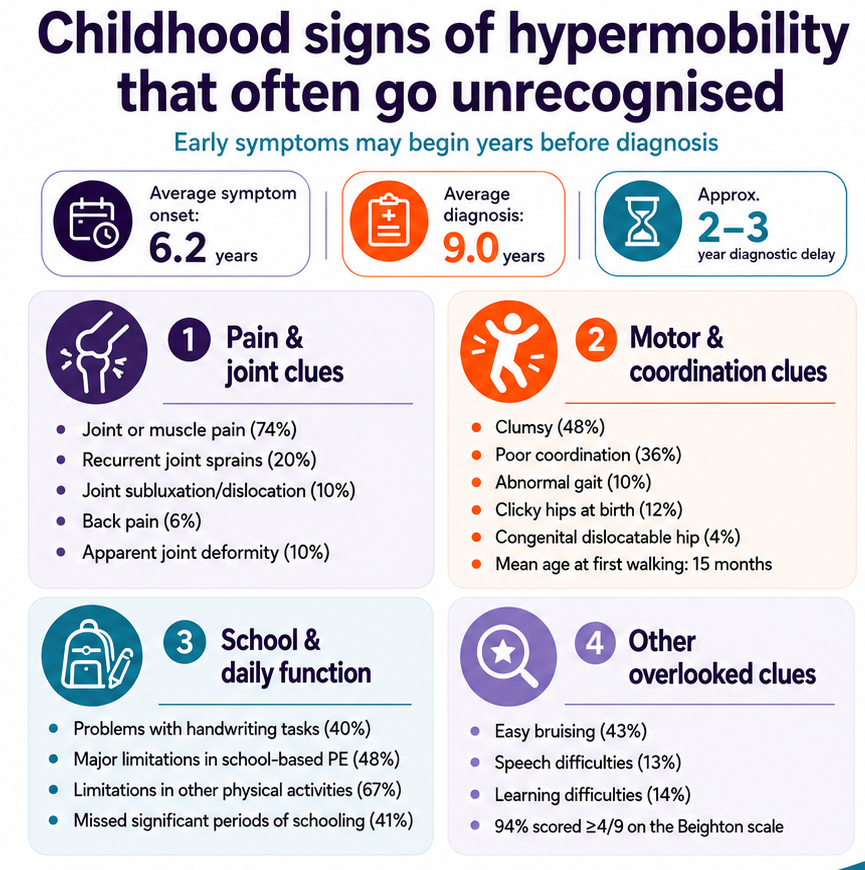
For many people, it starts in childhood as something completely ordinary:
- being able to do the splits
- bending fingers or thumbs further than everyone else
- sitting in unusual positions
- being great at yoga, gymnastics, or dance and never having to stretch
- being called “double-jointed” or being able to do “party tricks”
- frequently rolling an ankle
- being described as clumsy or having poor handwriting
- having unexplained “growing pains”
- feeling that joints click, move or give way more than they should
- Not having to stretch much before a yoga class and still touch the floor [2, 3].
Joint Hypermobility simply means that one or more joints move beyond the range expected for that person’s age and population. It is particularly common in children and young people and generally becomes less obvious with age [1, 2, 3].
So being bendy is not, by itself, unusual. The question I am much more interested in is this: what happens when you are bendy and you have other symptoms?
That is when it pays to look at the bigger picture.
Are you Hypermobile, or think you may have HSD or hEDS?
Take our 15-min evidence-based online test to find out if you might benefit from professional support.
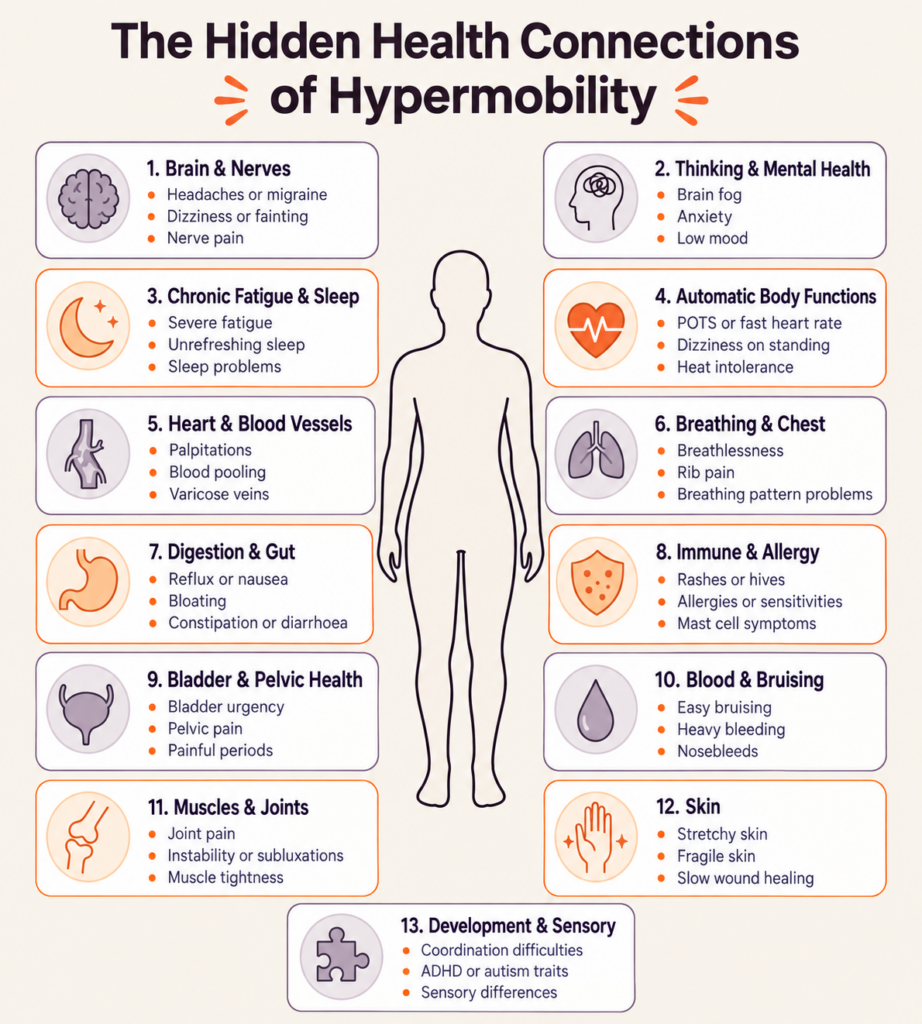
In clinical practice, I rarely become concerned simply because somebody can bend a bit more here or there across their body. I start asking more questions when Hypermobility sits alongside a pattern of problems.
For example:
- Do you repeatedly sprain or strain joints?
- Do joints give way, slip, sublux, or dislocate?
- Do you have widespread, persistent, or chronic pain?
- Are your muscles constantly tight even though your joints are flexible?
- Do you fatigue or feel the heat far more than you think you should?
- Do you struggle to stand or sit in one position for long periods?
- Have you always been unusually clumsy or poorly coordinated?
- Do you have dizziness or palpitations (racing heart)?
- Do you have persistent gastrointestinal problems (bloating, gut pain, diarrhoea, or constipation)?
- Migraines or headaches?
- Do you feel anxious or depressed?
- Sleep disturbance?
- Pelvic or bladder problems?
- Significant fatigue that sleep does not relieve?
- A long list of apparently unrelated diagnoses?
One symptom by itself tells us very little. The symptom list above reflects commonly reported problems in individuals with hEDS and HSD [3, 5, 6].
The 2025 global survey also demonstrated a high multisystem burden, with participants with hEDS reporting an average of 24 co-occurring conditions [5]. Again, this does not prove that Hypermobility, hEDS or HSD causes every one of those conditions. It does tell us that for many patients, healthcare becomes highly fragmented. What we do know is that many signs of a broader health condition related to symptomatic Hypermobility begin in childhood, and these signs and symptoms are often dismissed.
When multiple symptoms occur in a hypermobile person, this pattern is important because it often reflects a broader systemic health problem. It means we should stop looking at every symptom in isolation and ask whether there is a broader clinical picture.
Being Hypermobile is a physical trait
HSD and hEDS are conditions in which hypermobility is accompanied by symptoms that affect everyday life.
Not everyone who is hypermobile becomes unwell. Research suggests only some people develop ongoing symptoms such as pain, fatigue, joint problems or other health issues. Having symptoms does not automatically mean you have hEDS, but hypermobility can be an important piece of the puzzle when trying to understand ongoing health problems.
Older research suggests that up to 10% of people have joint hypermobility, and that around 3 – 4% of adults may experience joint hypermobility together with chronic widespread pain, although this is not the same as having a diagnosis of HSD or hEDS [7, 8]. A large Welsh study found hEDS or the older diagnosis of Joint Hypermobility Syndrome in about 1 in 500 people [4].
It is hard to give one exact number because studies use different age groups, populations and ways of assessing hypermobility, HSD and hEDS. If you are unsure what these terms mean, our Hypermobility Glossary is a good place to start.
What we do know is that symptomatic hypermobility, HSD and hEDS affects many people and that these conditions are still often missed or misdiagnosed.

The diagnostic odyssey: Why it takes so long
This is one of the parts of the research that concerns me most. People with HSD and hEDS are often symptomatic for years before somebody puts the pieces together. In fact, it takes up to 22 years to get a diagnosis of hEDS and 18 years for HSD [5]. Part of the problem is that hypermobility produces a wide and seemingly unrelated constellation of symptoms:
- A GP might treat the anxiety,
- An orthopaedic surgeon might treat the shoulder
- A gastroenterologist might investigate the gut
- A cardiologist might look at symptoms of your racing heart, dizziness, and fatigue
- A neurologist would treat your headaches and migraines…
What may be missing is someone standing far enough back to see the whole person.
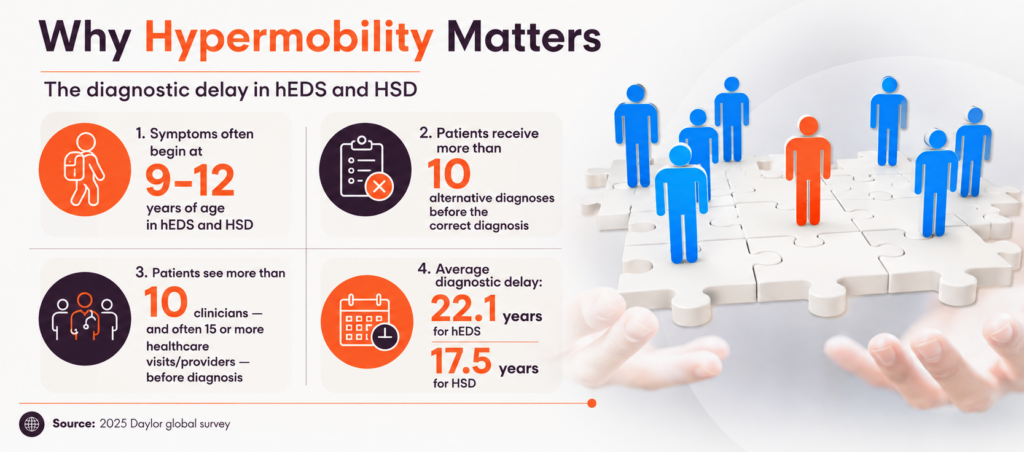
The 22-year problem we need to talk about: It could be costing you more than money
A delay of that length is not just frustrating. It quietly accumulates cost, in money and in wellbeing, long before anyone names the problem.
Your finances are taking a hit you don’t even realise
- The average patient sees 10+ specialists before getting a correct diagnosis [4, 6]
- That’s over 10 referrals, 10+ out-of-pocket costs, 10+ rounds of tests – for conditions that were all the same problem, and sometimes diagnoses that aren’t real
- Treatments that don’t work because the underlying cause hasn’t been identified
- Time off school or work, reduced capacity, career impact – all compounding quietly over years
Your mental health is paying the price
Chronic pain is hard enough. Chronic pain and health conditions that nobody believes is something else entirely.
The mental health data around undiagnosed and mismanaged hypermobility is sobering:
- Anxiety affects up to 70% of hypermobile patients, a rate far above the general population [5, 9]
- Depression affects around 30% of people with hEDS [5, 9]
- Years of being told repeatedly that your symptoms are imagined – by doctors, specialists, leaves a mark that outlasts the appointments and leads to what researchers call “clinician-associated traumatisation” – lasting psychological harm from invalidating medical encounters [10]
- 94% of hEDS patients had been told by a non-psychiatrist that their symptoms were psychiatric [9]
- Children are still told they are “anxious,” that it’s “growing pains,” or that “you’re just clumsy” [11]
- People with hypermobility – particularly women – are routinely told their symptoms are not real.
Are you Hypermobile, or think you may have HSD or hEDS?
Take our 15-min evidence-based online test to find out if you might benefit from professional support.

So what? I feel fine.
This is the section I most want young, active, and often healthy readers to pay attention to.
If you’re flexible and feel okay right now, it’s tempting to ignore all of this. I understand that. But here’s the thing about hypermobility: it doesn’t always hurt at first. The damage it causes can be cumulative and largely silent – building up over years before it becomes obvious. And by the time it does become obvious, it’s much harder to manage. Think about:
- The person who kept rolling the same ankle, year after year
- The dancer who continually develops knee, hip, ankle, or back pain
- The teenager who was always described as having poor handwriting, being clumsy, or accident-prone
- The swimmer whose shoulder repeatedly feels unstable
- The person in their 30s who was bendy and now suddenly develops widespread pain with no clear cause…
AND then ask yourself, “Do I have other health issues?”
A missed Hypermobility diagnosis often means several other conditions go unmanaged as well
In 2025, Veronica Daylor and colleagues undertook research with nearly 4,000 HSD- and hEDS-diagnosed individuals and found these Common Conditions that cluster with hEDS and HSD include:
- Chronic pain- 99% of hEDS and 93% of HSD patients also report chronic pain
- Fatigue -99% of hEDS and 95% of HSD patients also report fatigue or chronic fatigue syndrome
- allergies and mast cell activation disorders – 90% of hEDS and 78% of HSD patients also report allergies and Mast cell activation disorders
- anxiety and depression – 75% of hEDS and 72% of HSD patients also report anxiety
- dysautonomia, dizziness, racing heart, sensory and gut difficulties: including POTS – 71% of hEDS and 40% of HSD patients also report Dysautonomia and POTS
- headache and migraine – 64% of hEDS and 47% of HSD patients also report headache and migraine disorder
- neurodivergent conditions – 49% of hEDS and 40% of HSD patients also report ASD and or Autism
- gastrointestinal symptoms – 48% of hEDS and 37% of HSD patients also report gut and digestion conditions
- sleep disturbance – 38% of hEDS and 27% of HSD patients also report sleep disorders
- pelvic and bladder symptoms [5]
Many other researchers have studied the links between HSD and hEDS in these conditions; for more information, see the references below [10, 13, 14, 15, 16, 17].
One of the most important things to understand about hypermobility is that it rarely occurs in isolation. The same connective tissues that make your joints loose can also affect other body systems, and the interaction between your connective tissue and other systems needs to be considered.
Having a clearer understanding that hEDS and HSD are increasingly recognised as conditions associated with symptoms extending beyond the musculoskeletal system and that your symptoms could all be related and relevant.
Knowing now means you can do something about it. That’s not a burden – it’s an advantage.
It’s POWERFUL to have the correct information.
Are you Hypermobile, or think you may have HSD or hEDS?
Take our 15-min evidence-based online test to find out if you might benefit from professional support.
Why early diagnosis changes everything
But here’s what the research also shows: diagnosis itself is therapeutic.
Survey data from the EDS community found that receiving a correct diagnosis brought significant relief and improved overall wellbeing, even without any change in treatment [18]. Knowing why your body works the way it does – and that you’re not imagining it – matters enormously. The evidence here is clear and encouraging. When hypermobility is identified early and managed well, outcomes are significantly better across the board. After receiving a correct diagnosis, patients in one large study saw a 52% reduction in the number of clinicians they needed to see – because their care finally made sense [6, 18].
The foundation of good management is a holistic approach to health care and individualised, exercise-based rehabilitation that takes into account all of your co-occurring conditions, rather than medication or surgery [1, 19]. Specifically:
- Proprioceptive training – retraining the brain’s joint-position sense; research shows this directly reduces symptoms [20]
- Graded Exercise – that should always be monitored for POTS and Post-exertional malaise [20, 21, 22]
- Strengthening – building the muscular support that compensates for lax ligaments and soft tissues
- Controlled movement – learning to move well, not just move more
- Pacing – understanding your limits to avoid the boom-bust cycle of overdoing and crashing
Managing related conditions, POTS, gut symptoms, fatigue, mental health, as part of a coordinated picture, rather than in isolation, also makes a significant difference [19].
The single most important first step is simply finding out. If you’re not sure whether you’re hypermobile, take our free self-screening test. It takes less than 15 minutes and has now been completed by tens of thousands of people across the world. If your result suggests hypermobility, the Ehlers-Danlos Society’s Find a Provider directory can help you locate a practitioner with the right experience.
You don’t have to wait 22 years.
Are you Hypermobile, or think you may have HSD or hEDS?
Take our 15-min evidence-based online test to find out if you might benefit from professional support.
References
- Russek LN, Stott P, Simmonds J. Recognizing and Effectively Managing Hypermobility-Related Conditions. Physical therapy. 2019;99(9):1189-200. DOI: 10.1093/ptj/pzz078 https://pubmed.ncbi.nlm.nih.gov/31158283/ https://pubmed.ncbi.nlm.nih.gov/31158283/
- Adib N, Davies K, Grahame R, Woo P, Murray KJ. Joint hypermobility syndrome in childhood. A not so benign multisystem disorder? Rheumatology (Oxford, England). 2005;44(6):744-50.
- Blajwajs L, Williams J. Hypermobility prevalence, measurements, and outcomes in childhood, adolescence and emerging adulthood: a systematic review. Rheumatol Int. 2023. https://pubmed.ncbi.nlm.nih.gov/37149553/
- Demmler, J. C., Atkinson, M. D., Reinhold, E. J., Mulhern, B., Atkinson, M. D., & Kirby, S. (2019). Diagnosed prevalence of Ehlers-Danlos syndrome and hypermobility spectrum disorder in Wales. BMJ Open.
- Daylor, V., Griggs, M., Weintraub, A., et al. (2025). Defining the Chronic Complexities of hEDS and HSD: A Global Survey of Diagnostic Challenges, Life-Long Comorbidities, and Unmet Needs. Journal of Clinical Medicine, 14(16), 5636. https://www.mdpi.com/2077-0383/14/16/5636
- Halverson, M., Cao, S., Perkins, A., & Francomano, C. (2023). Comorbidity, misdiagnoses, and the diagnostic odyssey in patients with hypermobile Ehlers-Danlos syndrome. Genetics in Medicine Open, 1(1), 100812. https://www.gimopen.org/article/S2949-7744(23)00821-X/fulltext
- Tinkle B, Castori, M., Berglund, B., Cohen, H., Grahame, R., Kazkaz, H., & Levy, H. Hypermobile Ehlers–Danlos syndrome (a.k.a. Ehlers–Danlos syndrome Type III and Ehlers–Danlos syndrome hypermobility type): Clinical description and natural history. American journal of medical genetics Part C, Seminars in medical genetics. 2017.
- Hakim AJ, Sahota A. Joint hypermobility and skin elasticity: the hereditary disorders of connective tissue. Clin Dermatol. 2006 Nov-Dec;24(6):521-33. doi: 10.1016/j.clindermatol.2006.07.013. PMID: 17113970.
- Lee, S., & Chopra, P. (2025). The Incidence of Misdiagnosis in Patients with Ehlers-Danlos Syndrome. Children. https://www.ncbi.nlm.nih.gov/pmc/articles/PMC12191865/
- Halverson CME, Penwell HL, Francomano CA. Clinician-associated traumatization from difficult medical encounters: Results from a qualitative interview study on the Ehlers-Danlos Syndromes. SSM Qualitative research in health. 2023;3:100237.
- Chronic Pain Australia. National Kids in Pain Report 2025 [Internet]. Australia: Chronic Pain Australia; 2025 https://chronicpainaustralia.org.au/wp-content/uploads/2025/09/National-Kids-in-Pain-Report_2025.pdf
- Demmler, J. C., Atkinson, M. D., Reinhold, E. J., Mulhern, B., Atkinson, M. D., & Kirby, S. (2019). Sex differences in EDS diagnosis timing. BMJ Open.
- Wallman, D., Weinberg, J., & Hohler, A. D. (2014). Ehlers-Danlos Syndrome and Postural Tachycardia Syndrome: a relationship study. Journal of the Neurological Sciences. https://pubmed.ncbi.nlm.nih.gov/24685354/
- Fikree, A., Chelimsky, G., Collins, H., Grahame, R., & Aziz, Q. (2020). Prevalence and Predictors of Gastrointestinal Dysmotility in Patients with Hypermobile Ehlers-Danlos Syndrome: A Tertiary Care Center Experience. Digestive Diseases and Sciences. https://www.ncbi.nlm.nih.gov/pmc/articles/PMC7255528/
- Exploring shared pathophysiology between Long COVID and hypermobility spectrum disorders. (2024). Frontiers in Medicine. https://www.ncbi.nlm.nih.gov/pmc/articles/PMC11410636/
- Eccles, J. A., Thompson, B., Themelis, K., Amato, M. L., Stocks, R., Pound, A., & Bond, R. (2022). Joint Hypermobility Links Neurodivergence to Dysautonomia and Pain. Frontiers in Psychiatry. https://www.ncbi.nlm.nih.gov/pmc/articles/PMC8847158/
- Gagnon, C., Burger, F., Briot, K., & Hamonet, C. (2023). Exploring Comorbidities in Adolescent and Young Adults with Hypermobile Ehlers-Danlos Syndrome with and without a Surgical History. Children. https://www.ncbi.nlm.nih.gov/pmc/articles/PMC10528958/
- hEDS diagnosis brings relief, helps overall well-being, survey says. (2022). Ehlers-Danlos News. https://ehlersdanlosnews.com/news/heds-diagnosis-brings-relief-helps-overall-well-being-survey/
- Hakim A. Hypermobile Ehlers-Danlos syndrome. In: Adam MP, Bick S, Mirzaa GM, et al., editors. GeneReviews® [Internet]. Seattle (WA): University of Washington, Seattle; 1993-2026. Updated 2024 Feb 22.
- Ferrell, W. R., Tennant, N., Sturrock, R. D., Ashton, L., Creed, G., Brydson, G., & Rafferty, D. (2004). Amelioration of symptoms by enhancement of proprioception in patients with joint hypermobility syndrome. Arthritis & Rheumatism.
- Raj SR, Fedorowski A, Sheldon RS. Diagnosis and management of postural orthostatic tachycardia syndrome. Cmaj. 2022;194(10):E378-e85.
- F Tyson S. Appraisal of Clinical Practice Guideline: National Institute for Health and Care Excellence (NICE) clinical practice guideline for myalgic encephalomyelitis (or encephalopathy)/chronic fatigue syndrome: diagnosis and management. Journal of Physiotherapy. 2024;70(2):155-.